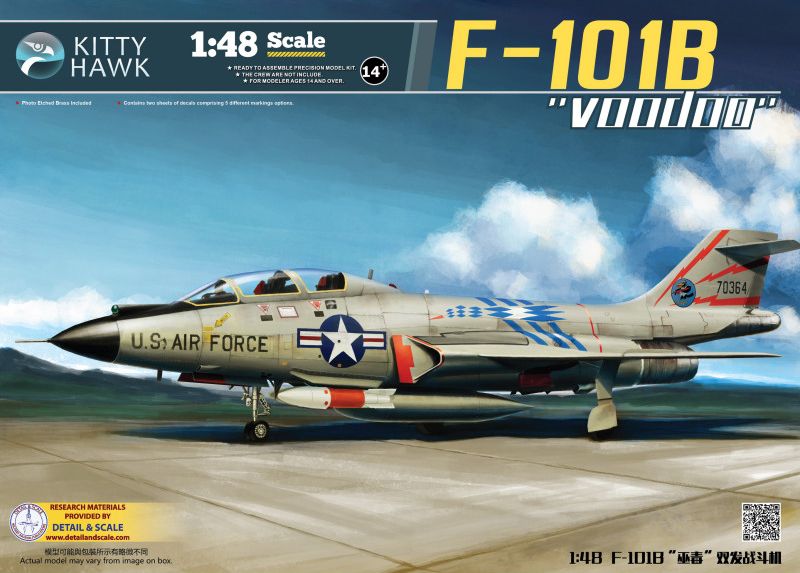
F-101 b/rf-101b 1:48 Kittyhawk 80114
 0
0
 ・Kup teraz i zapłać za 30 dni
Order now, we will ship
Description
Plastic model airplane to assemble: F-101 B/RF-101B 1:48 Kittyhawk 80114
We present the plastic model to assemble of the F-101 B/RF-101B airplane in 1:48 scale, produced by Kittyhawk. This detailed kit allows you to build an accurate replica of one of the American jet fighters from the Cold War era, the McDonnell F-101 Voodoo.
Model specifications:
- Scale: 1:48
- Manufacturer: Kittyhawk
- Catalog number: 80114
History and development of the F-101 Voodoo:
The McDonnell F-101 Voodoo is a supersonic jet fighter designed and produced by the American company McDonnell Aircraft Corporation. Work on the F-101 began in the late 1940s as a long-range escort fighter project for the Strategic Air Command (SAC) of the United States Air Force (USAF). This aircraft was also adapted as a nuclear-armed fighter-bomber for the Tactical Air Command (TAC) and as a reconnaissance aircraft.
The first flight of the F-101 took place on September 29, 1954. The F-101A version set world speed records for jet aircraft, reaching a speed of 1,207.6 miles (1,943.4 km) per hour on December 12, 1957.
F-101B Voodoo:
Due to delays in the interceptor fighter project from 1954, the F-101B Voodoo was chosen as a temporary interceptor fighter. This required significant modifications, including the addition of a large radar in the nose of the aircraft, a second crew member to operate it, and a new weapons bay with rotating doors that housed four AIM-4 Falcon missiles or two AIR-2 Genie rockets.
The F-101B entered service with the USAF Air Defense Command in 1959 and with the Royal Canadian Air Force (RCAF) in 1961. Although the Voodoo achieved moderate success, it was an important evolutionary step towards its successor, the F-4 Phantom II, one of the most successful Western fighter designs of the 1950s.
The Voodoo's career as a fighter-bomber was relatively short, but reconnaissance versions served for a longer time. The RF-101 Voodoo reconnaissance version played a key role during the Cuban crisis and was extensively used during the Vietnam War. Interceptor versions served in the Air National Guard until 1982, and in Canadian service, they were part of NORAD until they were replaced by the CF-18 Hornet in the 1980s.
Assembly and painting kit. Does not include paints or glue. To assemble, separately sold modeling tools are needed (including cutters, files, tweezers), paints, brushes, and plastic model glue (e.g., Tamiya Extra Thin Cement). The photo shows a professionally assembled and painted model.
Details
Product reviews (0)

There are no reviews for this product yet.
Log in to add a review.
 All reviews (positive and negative) are displayed. We don't verify that they come from customers who have purchased the product.
Check out what other modelers are choosing – the most popular products!